
Committed to Complexity
Long Form Reading as Resistance in an Age of Oversimplification


A few weeks ago, I had the privilege of preaching on John 11 and the story of Jesus raising Lazarus from the dead. I love this story, not just because it involves grieving siblings and a death-to-life miracle. I love it because John offers us a different perspective on two Biblical characters who have too often been defined by their worst moments: Thomas and Martha.
Thomas (monikered “Doubting Thomas”) is most often remembered for his faltering faith, that moment of grief and trauma where he couldn’t find it in heart to believe that the Lord had resurrected.
Martha is the practical, self-striving, bossy older sister who was too preoccupied with housework to sit at the feet of Jesus like pious Mary.
But in the lead up to Lazarus’s resurrection, both of these individuals complicate the simplistic narrative we are often told about their characters. Thomas, (the doubter) demonstrates great faith in his willingness to return to Jerusalem even though religious leaders are plotting Jesus’s death: “Let us also go, that we may die with him” (John 11:16), Thomas says. Mary (the busybody) demonstrates remarkable faith by making one of the most wholehearted and definitive statements on Jesus’ divinity in all the gospels: “'Yes, Lord,’ she replied, ‘I believe you are the Messiah, the Son of God, who is come into the world’” (John 11:27).
These moments, however, are rarely highlighted. They are often lost between the lines of scripture, the monikers maintained.
We like simple stories, don’t we? We like to be able to put someone in a box. We like straightforward cautionary tales and demonstrable fables. We like placing people into categories: hero or villain, sinner or saint, martyr or mischief maker.
The Bible doesn’t do this though. Our holy scriptures seem almost recklessly intent on bad-mouthing its own protagonists (David was an adulterer and murderer, Moses pouted and disobeyed, Rebekah was a manipulator, and Peter denied his faith), and sometimes even humanizing its antagonist (God protected Cain even after he slayed his brother, Nebuchadnezzar eventually turned to God, and Saul - later Paul - repented of his violent vigilantism).
Moreover, the Bible tells very few simple stories. Israel’s history is case in point. God’s people meander back and forth between faithfulness and faithlessness. Their circumstances are politically, geographically, and ancestrally fraught. Their struggles are so multifaceted that God uses poetry, song, history, and prophecy to provide layers to narrative. God told the long, arduous story of his salvific work, of human belovedness and failure, and of redemption in no less than 750,000 words (if you are reading it in English, that is).
That’s a lot of words. That’s a lot of reading. And we aren’t really good at reading these days, are we?

In his pivotal work Amusing Ourselves to Death, Neil Postman writes about a time in American history when people had the capacity and attention span to read long form, persuasive political discourse. Debates between political rivals would last for hours and hours, and people sat attentively through it all. Postman talks about how farmers would carry books and exhaustive government treatises to the field to read while they were plowing and sowing.
But these days, books have been largely replaced by social media. Paragraphs have been swapped for soundbites and quick quips. We like rallying around the memorable slogans: Make America Great (or Healthy!) Again, Defund the Police, Build the Wall, Put I.C.E. on Ice, or Drain the Swamp without taking the time to unpack the practical policies (the how) behind our catchphrases. We elevate our preferred politicians as either fault-free champions or fully-flawed saboteurs.
But this isn’t working, right? By almost every measure, we are more disconnected, more mentally unwell, more politically and socially disenchanted than we’ve ever been before. If you dig into the data, most of your neighbors would probably fall into the category of moderate when it comes to policies and politics. But it’s the extreme voices that commandeer the internet. The noise on social media makes us believe anyone on the opposing side is radical: violent, unpatriotic, ignorant, vindictive. So, we live in fight or flight (a disposition that significantly reduces our ability to think rationally and complexly). It’s a cycle really. The bombastic, simplistic headlines scare us. We fester in that fear. Therefore, we are unable to absorb anything other than simplistic, bombastic headlines.
So how do we get out of this cycle? How do we get off the hamster wheel of hate that we’ve found ourselves on (and that plenty of media corporations and influencers are profiting off of).
Resistance might be as simple as strengthening our attention spans. It might mean reading a book or a long form article from a reputable journalist about an issue (like Palestine/Israel or Immigration or DEI) rather than simply reading a tweet. And I get it…it’s hard to make time to read in between jobs and kids and life. So maybe it’s listening to two subject matter experts debate on a podcast…or listening to a podcast that represents differing view than the ones you hold, judging for yourself the merits of the argument rather than letting someone else do it for you.
And perhaps, most importantly, its having deeper, more vulnerable conversations with your neighbors and family members, even those who you know see things differently than you. Instead of going into the conversation with the goal of winning them to your side, aim to understand and to be understood. Ask questions like: “How are you processing all the changes in immigration policy?” or “What was it like for you when news of that political assassination broke? How are you feeling now?” or “Here’s something I’m learning lately. What’s something you’ve been learning?” or “I wonder where the common ground here might be?”
As long and complex as the Bible is, Jesus has a way of offering elegant summaries that can steady us as we approach the complexity: Love the Lord your God with all your heart, soul, and mind. And love your neighbor as yourself. “All the Law and the Prophets hang on these two commandments” (Matthew 22:40)
If love is the lens by which we view all this complexity, then I believe we can develop the capacity to take it on, not because we believe we can singlehandedly solve the world’s many problems...but because maintaining our humanity requires us to get off this hamster wheel. When we dehumanize others (by hastily besainting them or hatefully belittling them), we dehumanize ourselves.
So practice attending to issues with your attention. Training our minds to slow down and weaning ourselves off the dopamine hit of doomscrolling is one of the best things we can do for democracy. Practice thinking again rather than being told what to think. Practice listening and sharing vulnerably. Practice courage instead of fear, calm instead of chaos. Stop skimming and start reading. (and believe you me, it takes PRACTICE, phew). Practice love, not just for the sake of your neighbor, but also for the sake of your own humanity.
AND NOW FOR SOME PROVISIONS:
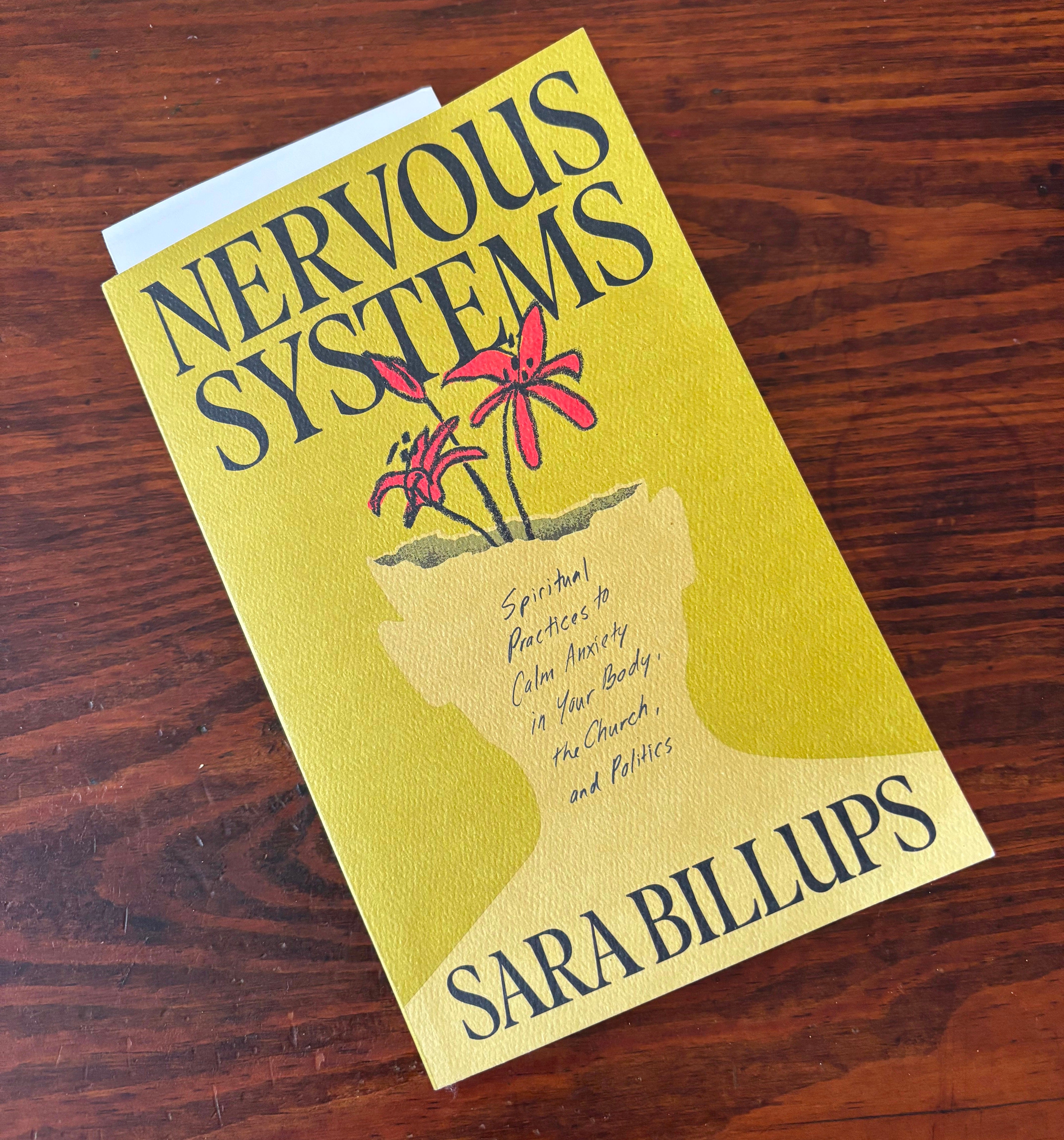
I’ve just finished reading Sara Billups brilliant new book Nervous Systems: Spiritual Practices to Calm Anxiety in Your Body, the Church, and Politics. This book almost unnerved me because it felt like Sara had been camping out in my brain for a month or two, and then wrote a book about what she’d seen. Her words helped name and shed light on all the things I spend my time worrying about, and offer yes, solidarity, but also a path forward. If you struggle with anxiety related to your health (or the health of someone you love), if you are a caregiver, if you find yourself nervous in church or spiritual spaces, or if politics has you pulling your hair out, I highly recommend this book. Here’s a snippet:
“The more I thought about the personal, the church, and the political anxiety of our era, the more my central tension crystallized: Jesus said to not worry, but it does not seem possible to live in our world free of personal and pervasive systemic anxiety. The two postures—Jesus’s calm and our worry—did not seem reconcilable. They weren’t, until some- thing changed in my own heart.”
And finally, since I’m encouraging everyone to sit at tables and have conversations, I’d love to share the latest album from The Porter’s Gate: Table Songs. My friend Kendall Vanderslice helped bring this album to life by getting a bunch of food theologians, cooks, and food justice workers together with the phenomenal musicians at Porter’s Gate. It was so fun being a fly on the wall for the creation of these songs. I know you will love them.
Thank you so much for writing this! It’s a breath of much-needed fresh air to know someone else wants to recognize the complexities of the moment rather than the hot takes. I haven’t been able to avoid the latter, both on Substack and on social media right now, and it was truly weighing so heavily on met heart. This felt like the antidote.
And: I also loved Sara Billup’s Nervous Systems and felt like she had crawled into my brain to write it. 😆
Thank you for this, Amanda. Grateful for you.